Axes and allies
By Rose · August 15, 2026
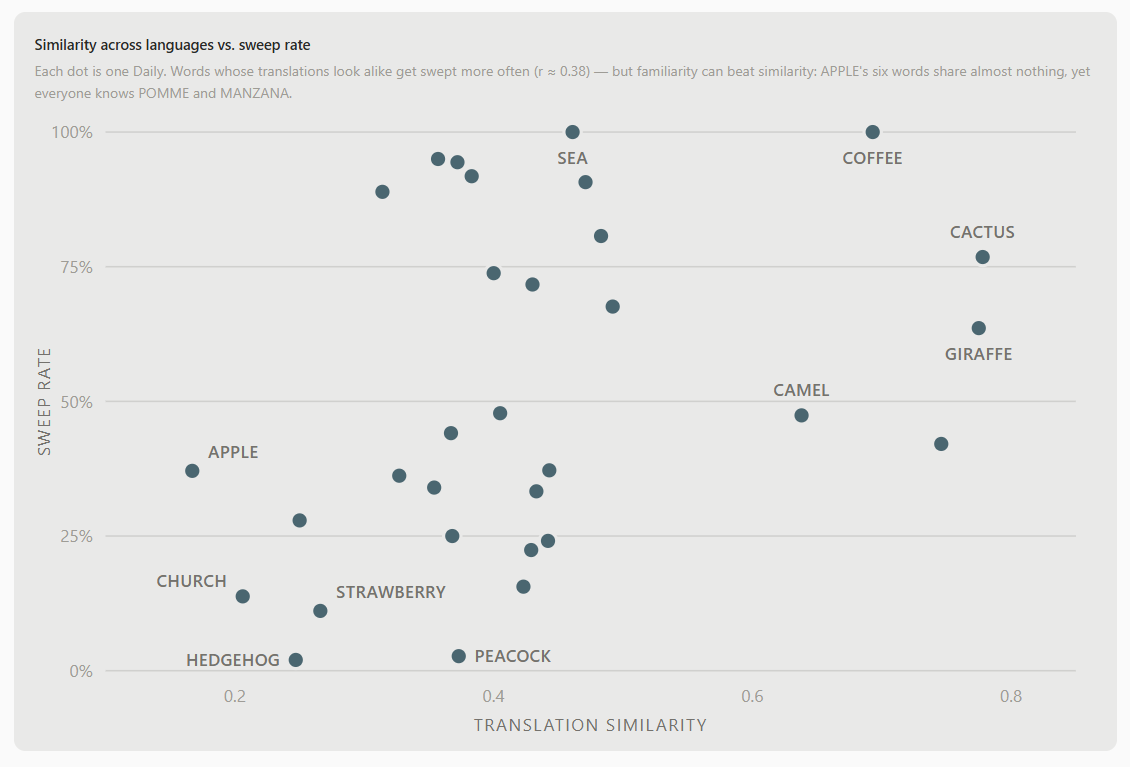
This chart screams "perfect content for a lazy summer Saturday", doesn't it? Well, maybe it's not Yesteryear (this year's bestselling beach read in the U.S., and a novel I can already tell is going to divide my book club) but it is lighter reading than might first appear. It shows the scrambles that TongueTied Daily players found most difficult (or not) in the first month of the game, with the trend line suggesting why. Whereas the words for "coffee", "giraffe" and "camel" are very similar across the languages we offer, "hedgehog", the creature that produced the fewest clean sweeps (just one!), is the opposite:
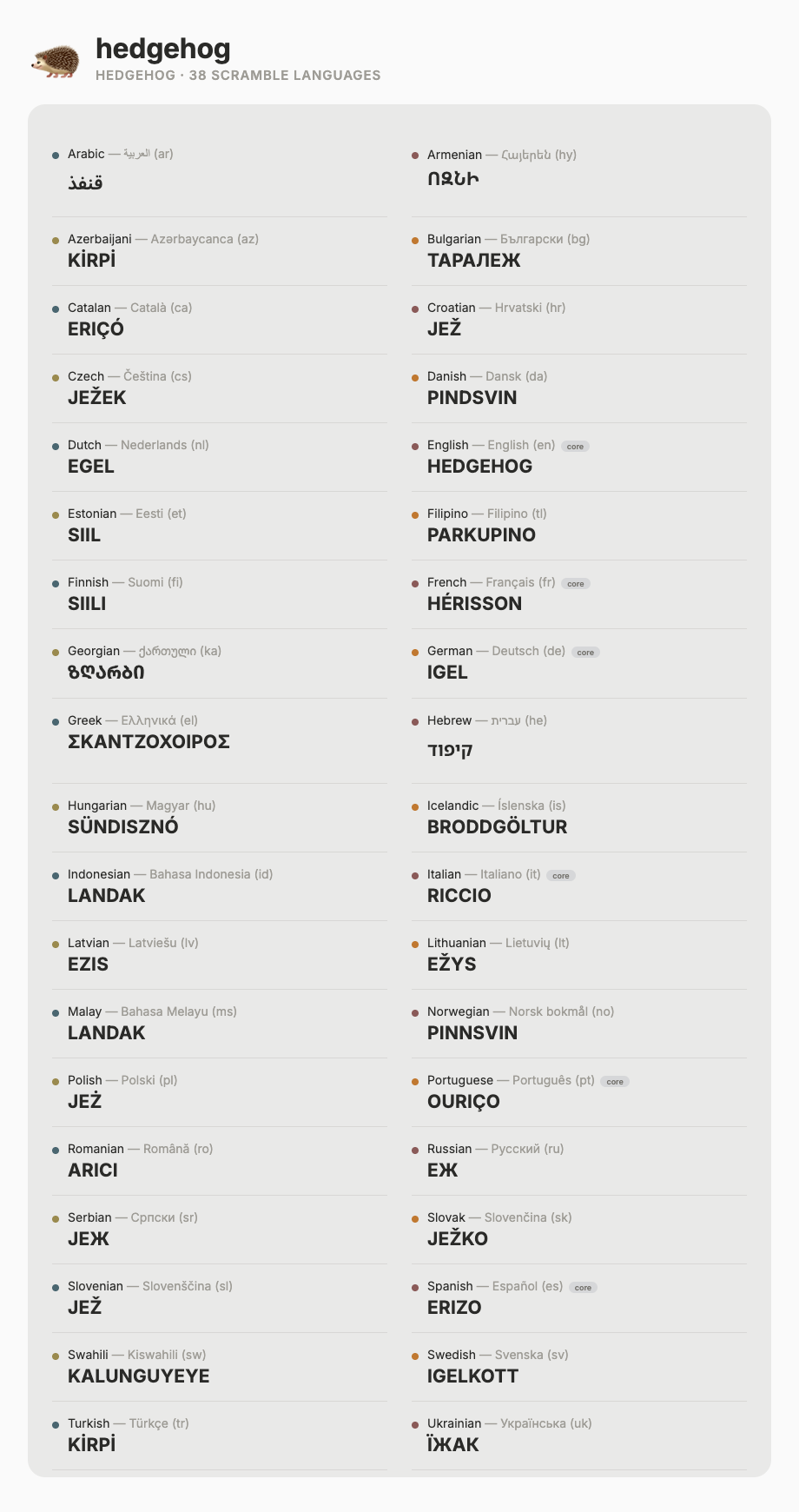
Why? James Harbeck, writing in The Week, points out that the word for butterfly also varies hugely across languages. In French, it's not beurre-mouche (butter-fly) but papillon, from the Latin papilio, likely related to how its wings move. In Russian, it's babochka (old woman), in Danish, sommerfugl (summer bird). And so on and so forth, with the speakers of each language choosing different observations or lore on which to build a name.
The hedgehog experienced something similar. English speakers thought it looked like a little pig scurrying along the edges of a garden, and called it thus, while German seems to have focused on what it eats: Igel is related to the ancient Greek for snake. Turkish speakers call a hedgehog a kirpi, which according to one source once meant prickle or thorn and also gave the eyelash its Turkish name (kirpik).
Whatever the word, the animals always remind me of Isaiah Berlin's essay "The Hedgehog and the Fox", in which hedgehogs – or the people with whom they are compared – come off rather badly. They see the world through one abiding framework, while the foxes observe and understand it from multiple angles. Berlin himself undermined the notion of a sharp divide between the two by arguing Tolstoy was both fox and hedgehog, and yet categorizing people by type has been a cottage industry ever since. Which brings us back to book clubs. Before tackling Yesteryear, mine read the excellent Euphoria, by Lily King, based on the life of Margaret Mead. In it, a thought experiment like Berlin's takes on a life of its own, to ill effect. Charts, we're reminded, are not to be treated lightly – even on a quiet weekend in August.