Finding structure in a post-9/11 world
By Rose · September 14, 2026
I first saw the name Greta Lupo a few months ago, when we were publishing leaderboards of the weekly TongueTied challenges that eventually became the TongueTied Daily. Greta was scoring in the top five every time, often finishing the puzzles in 20 seconds or less. Who was this multilingual speed demon? Then she challenged me to a TongueTied classic game, in English only, and started placing words like:
GRUNION
ANGINOUS
OYEZ
BIGUINE
To which I countered, BASH.
ZA
NO
It was getting embarrassing. As a sop to my ego, I pondered whether Greta was cheating. Also, where was she from? And why was she so good at this game? Soon I remembered that instead of stewing I could ask.
Greta replied as graciously to my request for an interview as to, two weeks later, the fact that I was wearing cat-ear headphones during the Zoom call (long story). She is neither German nor English (my guesses given her first name and impressive English vocabulary), but Italian, though she does split her time now between her hometown and London. In our call, she was as poised as her namesake, Greta Garbo. Rather than pursuing acting, however, she’s working towards a law degree.
She’s also a singer and songwriter. Last week, Greta released a single, “I’ll wait for you”. That it came out on the 25-year anniversary of the September 11 attacks was happenstance, but there are strands of the ballad that resonate with the date, particularly in the song’s focus on love, memory, and “the longing for a gentler past”.
Greta was four months short of her third birthday on September 11, 2001, and yet her mother’s reaction was indelible. “We were in a supermarket, and she started panicking, along with the rest of the store. She was screaming, really, saying again and again, ‘Dio mio, Dio mio’. It’s one of my first memories.”

You arrived at TongueTied via the TikTok personality Lingualizer, who was running tournaments of TongueTied scramble challenges. Were you participating? And how did you discover Lingualizer?
He popped up on my TikTok feed about a year ago, probably because the algorithm picked up on my interest in geography and languages. I’ve been following him since. I like his live interactive games, like “guess the city” or “find the mystery country”. It doesn’t feel like I’m wasting my time watching him; I value educational and mentally engaging material over passively scrolling. I took part in two tournaments, and placed fifth or sixth, I think. They were fun.
Tell me a little about your background, including your language background.
I grew up in southern Italy and I’ve been interested in languages for as long as I can remember. I started reading when I was three – in Italian, of course, but I started learning English soon after. My aunt lived in Japan for a while, and I remember her teaching me a few Japanese words when I was little. I began learning French at nine years old and Spanish at 12. I attended a linguistic high school, and performed in English and French in a few school plays and musicals – both in Italy and in the UK, where I was an exchange student.
My parents are both doctors, and languages were where I was different from them. Language was my thing.
Later, I did some of my law school in Madrid, which helped me solidify my Spanish, and I taught myself Portuguese during Covid. I can understand Romanian and I am learning Russian whenever I have the time.
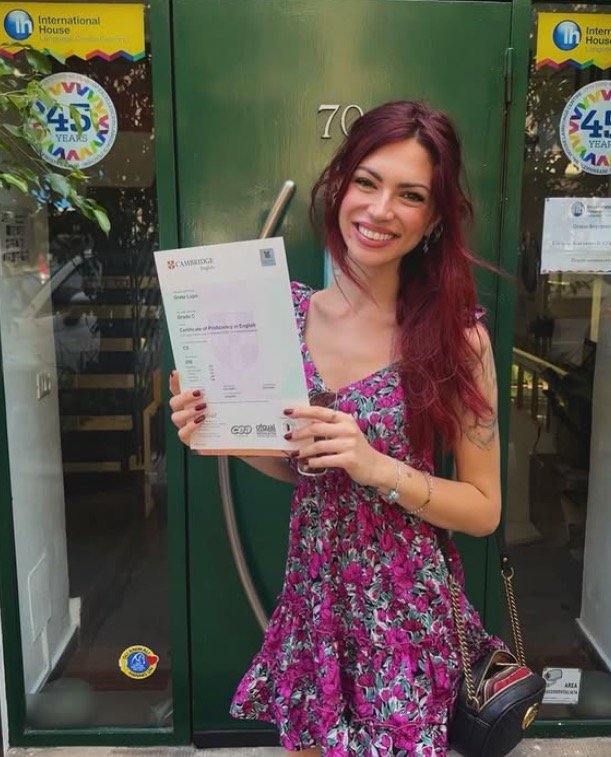
I love the challenge of trying to master things. A few years ago, I got my Cambridge C2 Proficiency certification, and I’ve been certified in a few other foreign languages, too. It might just be a formal piece of paper, but to me, the true value lies in the process itself. The discipline and the rigor required to get there deepened my understanding of the language. And a certification might be pretty useful in today’s global job market.
I'm consistently amazed by the words you're playing; they’re expanding my vocabulary. Are you a longtime player of word games?
Thank you, Rose. Your moves have expanded mine as well. I have been playing word, geography, logic, and language games since early childhood. I remember my father had these games I could do on his computer, all sorts of quizzes on all sorts of subjects, in Italian and English, I loved doing those, especially the geography quizzes.
Knowing geography gives me perspective. It helps me structure the world around me, and language is also a part of that: because it helps create culture, and is also shaped by culture, I learn about the people and customs of a place by learning the languages. I still play a number of word games online. I love JetPunk – there are so many topics, and users can submit quizzes of their own. As for TongueTied, it’s become one of my favorite websites to wake my brain up in the morning, or in the evening to decompress after the day.
As you've seen, your skills haven't really rubbed off on me. Do you have any tips for finding these long words in your letters?
I take my time. I play around a little with the tiles and test out different combinations against the board. Sometimes I do get strikes [playing all seven letters at once], but I usually prioritise identifying open board letters that can extend my hand to increase the score, or letters I can connect to a word I can already make with my own tiles.
With the Daily, in most cases I’m already familiar with the vocabulary I’m unscrambling. The only language I don’t speak is German, which is also why I was eliminated from Lingualizer’s tournaments. To solve German anagrams, I generally look for the closest spelling to English, since they share Germanic roots.
I’ve been playing word-unscramble games for a few years, so practice helps, as it does with everything.

Such as music. Any other interests?
Music is the most important one. Beyond that, I like travelling on my own, working out, reading and studying anything that could improve my education or come in handy, mentally and physically.
Are you tempted to bring other languages into the mix on the TongueTied board? Other players?
I am, especially because I’ve been playing practice mode in three different languages at the same time (either English-Italian-French or English-Italian-Spanish).
I’ve played a couple of times with friends who are also into word games, but most of my matches have been with you and Eric, one of the other TongueTied creators. A “random player” feature would be interesting in the future. I think it would be nice to challenge other people around the globe.
They’d be in for a world of hurt.
But I want you to do well, too! Yes, I’m competitive, but I’m competing against myself. I only care about doing better today than I was doing yesterday.